Sunday, October 15, 2017

Green Akureyri

Day 9  Akureyri, Iceland  Tuesday, Sept 19, 2017

A beautiful day in northern Iceland, located at the end of the country's longest fjord. Our arrival time of 10 am allowed us to sight-see during its 40-mile length, and it was green and mountainous, with snow-capped peaks, and a few waterfalls.
Here we were drinking our morning coffee in the 13th floor lounge, enjoying the fjord and its serene beauty. Yes, I take my flavored coffee creamer with me on trips!

Our route to get here had been north along the west coast of Iceland, then east over the top, touching the Arctic Circle, and south into this fjord.
Here's another view as we were approaching Akureyri. Because the fjord is so long and narrow, the water was completely calm. Passengers spotted whale dorsal fins a few times, but there wasn't much of the whale to see (thus, no photos). Akureyri is Iceland's 2nd-largest town with just 17,000 population.
On the east side of the fjord, just before docking, was this steamy waterfall. It was dramatic to see the steam emanating from hot springs all along the river flowing to the fall, and then again as it poured into the cold ocean water. Later in the day, for some reason, there was no steam as the water poured into the ocean; I doubted that the temperatures of either the river or the ocean would have been different later in the day, but perhaps. Akureyri's geothermal electric generating plant was just above this on the side of the mountain.
It was chilly as we were docking, with Janet wearing her Basque lauburu cap.
From the ship I took this telephoto shot showing the downtown, and the modern Lutheran Church we visited later in the day.
Our excursion was titled "Akureyri and Santa's House." We started with the Santa House, which was basically a charming little gift shop a little ways south out of town. On the drive there, the guide told us about how the town was settled by Norse Vikings in the 9th century, but was not a permanent settlement until 1778.
Here's another view of Santa's House, but with Janet holding the bag of souvenirs we bought. We couldn't help but purchase some items after learning about the Icelandic Christmas traditions. Christmas lasts 13 days, with numerous family gatherings, sometimes two or three per day. Each of those 13 days, a different Yule Lad shows up to place either candy or a potato in a child's shoe, depending on how good the child has been. So, our first souvenirs were potato ornaments, for the naughty boys back home!

The names of the 13 Yule Lads, in order of their day to arrive at the home, are: Sheep-Clot Clod, Gully Gawk, Shorty, Ladle Licker, Pot Scraper, Bowl Licker, Door Slammer, Skyr Gobbler, Sausage Swiper, Window Peeper, Door Sniffer, Meat Hook, and Candle Beggar. We could only imagine the kind of fun that families would have each day depending on the name of that day's Yule Lad.

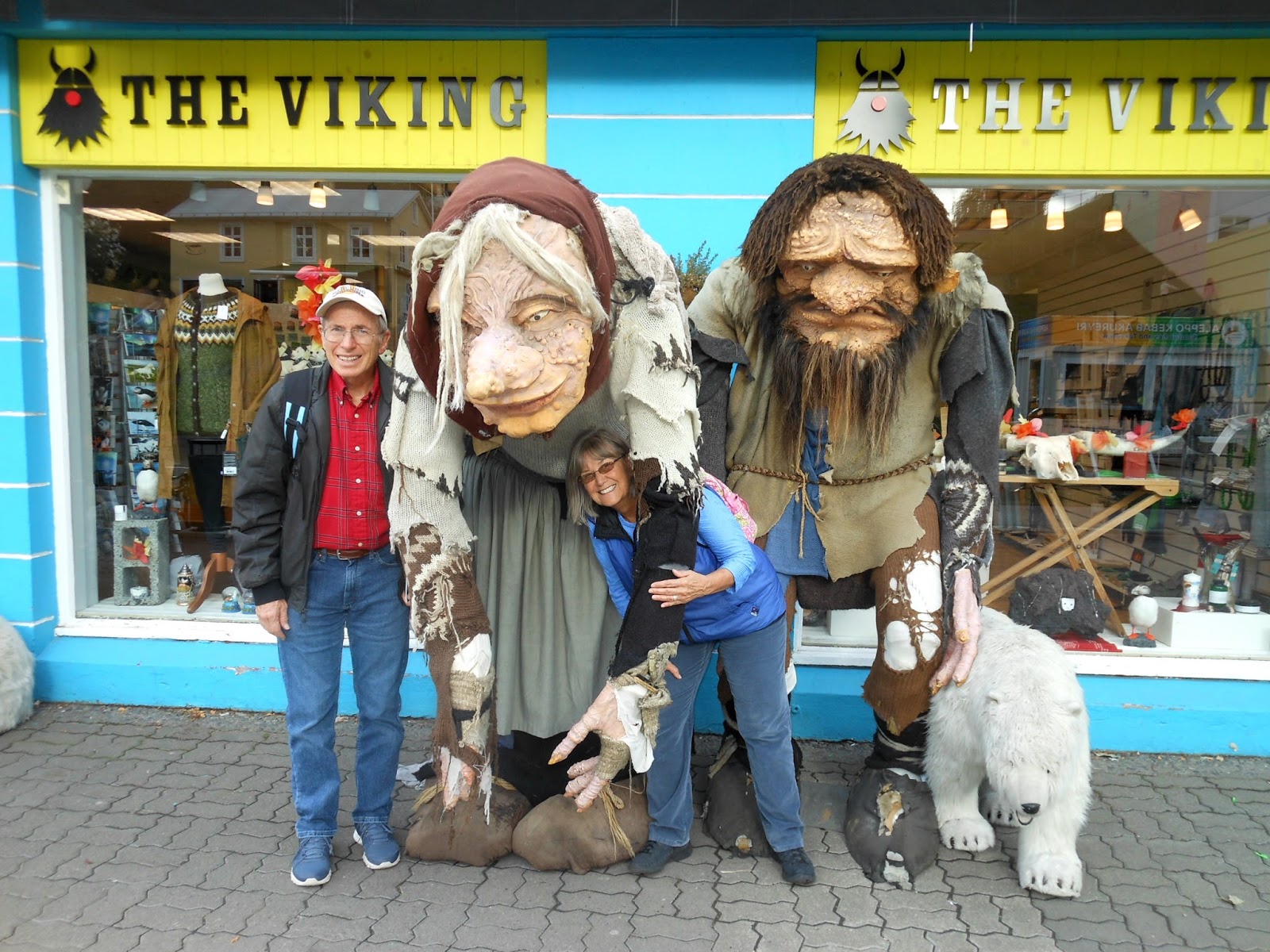
The "icing on the cake," so to speak, was the story of the Yule Lads' ugly, evil, and gigantic parents, Grýla and Leppalúði. Grýla, shown above, is the more evil because she puts bad children into her bag and takes them into the mountains where she devours them. "Her favorite dish is a stew of naughty kids for which she has an insatiable appetite. According to legend, there is never a shortage of food for Grýla." Her husband, on the other hand, is a hen-pecked weakling.
Here are Janet and I posing with Grýla and Leppalúði at a tourist spot in town later in the day. Anyway, you can guess that another souvenir we HAD TO BUY at Santa's House was these two characters.
These two photos were inside Santa's House, just a few of the hundreds of items on sale. Of course, I had to take the shelf with bicycles.
Next to the shop was The World's Largest Advent Calendar, inside this tower up the stairs.
On the walls of the tower were pictures representing nursery rhymes or famous fairy tales, with the 31 Advent boxes scattered about.
More of the story paintings. Can you identify the various tales? Goldilocks, Hansel and Gretel, Emperor's New Clothes, Cinderella, and ?
I noticed the Wicked Witch of the East in the flower bed, but the house did not look like Dorothy Gale's.
And finally, the ultimate touristy thing they had there, and we "had" to do it.
On the return bus ride to town, we crossed the river and drove across the countryside for some nice views back to the bay. If you look carefully (and enlarge the photo), you can see our ship.
Back in Akureyri, we stopped to see Nonni's House, built in 1850 and one of the oldest houses in town. He was a Jesuit priest who lived here only for a few years as a child, but became a beloved author of children's books. Thus, they turned this old home into a Nonni Museum.
A few yards away was this tiny church from 1846, moved here from across the bay to be part of the Akureyri Museum.
It was newly furnished in its interior.
Our next stop was supposedly a highlight, at their botanical garden ("the world's most northern botanical garden"). This area has a warm microclimate, so they are proud of what they can grow there. However, we did not find this visit too interesting. While Janet was using the restroom, I watched as Asian group after Asian group (from our ship) posed with this wheel barrow of flowers. Now THAT was interesting!
Our final tour stop was at the Lutheran Church, finished in 1940.
That organ had 3200 pipes, and we listened to them practicing on it. See that ship hanging from the ceiling?
It's a church highlight, this ship, which reflects an old Nordic tradition of giving offerings for the protection of loved ones at sea.
 I thought my photo of their alter stained-glass windows came out nicely.
We had a nice view of the town and bay from the church. You can see how sunny it was at times.
Akureyri modern art? As we walked from the church to get back on the bus, we looked down to some apartments and saw this artsy painted wall. We decided to memorialize it in this blog!
Our tour dropped us off at the ship in time for us to have lunch, and on our way across the pool deck to the buffet, we saw this sight for the only time on the entire two-week cruise - people relaxing in the sun! Most were asleep. Usually, you imagine cruises as being in warm climates and the passengers are forever crowding the pool deck. Not on this cruise to the Arctic! Speaking of, we touched the Arctic Circle while sailing both to and from Akureyri.
And, it was the only time Janet and I ate outside during this cruise (on other cruises, we oftentimes ate on the aft deck). This pretty view is looking north up the fjord, back toward the Arctic Circle (60 miles away).
 After lunch, we departed the ship to stroll around the charming downtown main street. Our tour guide earlier had said this street, only 100 meters long, was one of the shortest main shopping streets in the world. The next four pictures were taken along this street.


During our stroll, we stopped in a few shops to explore. Also on this street was the photo from before, of us with Grýla and Leppalúði.
 The red stop lights in Akureyri are heart-shaped! The city converted to these after the economic downturn in 2008, "when people's spirits needed some lifting up."

We had a nice day, even though we stayed close to town. Other excursions were more adventurous: into the nearby mountains, the Godafoss waterfall, volcanic craters, whale watching, lava formations, natural arches, and craggy grottos. There were excursions to Hrisey Island, with only 200 inhabitants, which we passed coming and going through the fjord. It's a virtual bird sanctuary because there are no foxes, minks, or cats. One favorite bird there is the ptarmigan, where avian scientists have studied its life and habitats.

Monday, October 9, 2017

Golden Circle geologic tour in SW Iceland

Day 8   Reykjavik   Monday, Sept 18, 2017


Exciting Gullfoss, Europe's largest waterfall. This photo doesn't show how far the final drop is into the canyon on the right of the picture (see later photos below). From this vantage point, you could not see the river below, so it was strange to see the water dropping into "nowhere". Today's all-day tour focused on Iceland's geological features, and was fascinating. The places we visited were called The Golden Circle, described in their publications as: "Explore the island's raw and rugged interior."
Our first stop was the UNESCO site, Thingvellir National Park. It's famous for a few reasons: 1) continental drift -- the North American and Eurasian tectonic plates continue to split apart from each other here, creating deep fissures and canyons; 2) Iceland's parliament, the oldest in the world, met here beginning in 930 AD; and 3) the lake and rivers are quite scenic.

I wanted to start by showing the view to the north, the large lake. The tectonic plate boundary is in the distance, but shifting occurs all over, including where our tour walked from the parking lot.
This photo is in the other direction (toward the south). There's a flag pole (no flag though) about 200 yards away, which is where the ancient parliament (Althing) gathered to hear 48 chieftains discuss laws & engage in court proceedings on behalf of the country’s citizens. Regular people also could step forward and give speeches about important matters. Althing continued here for 868 years, from 930 to 1798. Our tour guide said that sometimes it would take several days to recite a new law (it was all from memory, too, as they had no written language yet). Janet and I could not imagine sitting there for days listening to someone recite the details of a new law.
Two similar photos above, with an interesting story (one photo includes Janet, and the other shows how deep the ravine is). The tour guide told how when he was a boy, his family had day trips here and would drive their car right through this ravine where we are standing on this bridge. Prior to 2011, this was a gravel road leading into the valley below. But in 2011, they noticed a small hole in the road.
I took this photo of the board explaining what happened. See that small hole? They banged the hammer around and it kept exposing a larger and larger hole. It turned out the gap below was 30 feet deep and 45 feet long! They think it began during the earthquakes of 2000 and 2008, and then eroded away from rain and snowmelt.  They had to build the current wooden bridge to allow visitors to still reach the valley below.
This photo looks straight across the valley (westward, in the direction of Reykjavik). The tectonic plate boundary is a dark streak on the other side. Farther to the south, where we would visit later in the day, the plates inch past each other (the final photo in this entry shows this). But here, the plates break apart and the land between subsides. Away from the plate boundaries, the activity is fairly constant, about an inch per year; however, in the rift zones themselves, tensional stress accumulates during a long period and is then released in a burst of activity when fracture boundaries are reached. The most recent burst of activity swept over Thingvellir in spring, 1789 (just as George Washington began his first term as president).

The river in the photo above flows to the south (to the left) to a gorge called Silfra, where scuba divers explore the gap between the two tectonic plates.
I stole this photo from the Internet, but as our tour bus was headed away from the national park, we saw Silfra's parking lot full of cars and SUVs. Our guide said this was a popular diving spot because it's the only place in the world where you can dive between two continental plates. The cold glacier water is extremely clear.
Our next stop was Haukadalur, an active geyser area. On the bus ride there, we saw and learned about Icelandic horses, which are a hearty, separate breed developed from ponies taken there from Norway in the 9th and 10th centuries. They have few diseases; Icelandic law prevents horses from being imported into the country and exported animals are not allowed to return.
I stole this photo from the Internet. They are short, like a pony, and stocky (reminded us of the Shetland ponies). Selective breeding over the centuries has developed the breed into its current form, although natural selection has also played a role, as the harsh Icelandic climate eliminated many horses through cold and starvation.

Both our tour guide that day, and our guide the next day in Akureyri, proudly told of a special characteristic the horses have - an unusual gait, called the tölt. One leg is always on the ground, allowing a smoothness of the gait. They hold "beer tölt" competitions, whereby the riders are known for not spilling a drop of beer from their mugs as they gallop along.
 Back to the geysers. There were steam pots everywhere, but if you took a short walk, you could stand next to their own version of Old Faithful, called Strokkur. There was a 2nd famous geyser here called Geysir, after which the general term “geyser” was named. (The original Geysir no longer erupts after an earthquake shut it down.)
Here is Strokkur erupting 100 feet up, which happens every 8 to 10 minutes. I stole this photo from the Internet because I could not get a suitable photo during the two eruptions we witnessed up close (see those spectators in the photo? That's how close we were.) You could see that the eruption was about to happen because huge bubbles would surge up and down just prior. Our guide would say "Here it comes!" But it occurs and ends so quickly, I couldn't get my camera shutter to snap at the precise moment. It sure was exciting to experience!
Just one of many boiling pots as we walked to Strokkur and back.
Our next stop was Gullfoss, the two-tiered, 105-foot waterfall on the glacial Hvítá River. To get this close to the falls, you descended 94 steps from the parking lot and restaurant, where we ate lunch.
To get this close to the falls, you needed to walk about 400 yards farther, which Janet elected not to do with her sore ankle. If it had been sunny, we would have gotten rainbows.
I like this photo because it finally shows how far down the falls drop, into that narrow ravine. The tour guide said that in periods of flooding, the amount of water can be 10 to 12 times greater than it was here, almost completely filling that ravine.

Our salmon and cream of asparagus soup lunch was fabulous, served family style in the restaurant next to the visitor center. The Chinese man next to Janet kept reaching across in front of her to get more food from the food plates. Janet would offer to pass him the plate, but he would indicate "no thanks", but then reach across her to get it anyway. Differences in cultural habits! We also thought it was a bit "different" for the Indonesian woman across from us ask to have her American husband's salmon membrane to eat, which the rest of us discarded.

We learned about the 11-yr-old girl, back in the early 20th century, who so opposed the idea of building a huge hydro-electric generating plant there, that she walked to Reykjavik several times to protest the idea, and even threatened to throw herself off the falls if they moved ahead with their plans. The plan actually failed due to lack of money, and the falls were soon sold to Ireland to forever preserve them in their natural state. But the story of little Sigríður Tómasdóttir lives on, and there's a stone monument to her above the falls.
Our final stop was in the town of Hveragerdi, near the south coast. It's a famous geo-thermal spa area, but we visited an earthquake exhibit. In May, 2008, a 6.3 earthquake struck near here, and they re-created what people's kitchens and grocery-store shelves looked like afterward. To me, it looked exactly like what my own kitchen looked like after our Simi Valley 6.6 earthquake in 1994. "No big deal" to see this exhibit if you went through an experience of your own like that!

But to me, the photo above was the most interesting part. It turns out, the continental-plate rift went right through the floor of the earthquake exhibit! They put glass over the gap, which was about three feet deep. This is the part of the rift where the plates shift consistently about an inch each year, not where big shifts occur. Thus, they can put glass over it like this in the floor.

Our guide told interesting stories and provided Icelandic info all during the day, so we truly enjoyed The Golden Circle (even though the tour began at 6:45 am! Oh, how cruel it was to have our alarm go off that early in the morning. And we got a laugh when Janet yelled out to ask if I was in the bathroom, not realizing my ear was right next to her. Coming out of her deep sleep and without her coffee yet, Janet cannot be faulted for failing to notice a body next to her. lol)